Seminar in Hechingen

08. - 10.05.2026

Seminar in Hechingen 05/2026

Getting there

For the anniversary seminar marking 40 years of the Association for Ki, Aikido and Health, Maurizio from Novara, Bernhard and Geraldina from Balerna, and Dzenan from Lugano arrived in Hechingen on Friday evening.
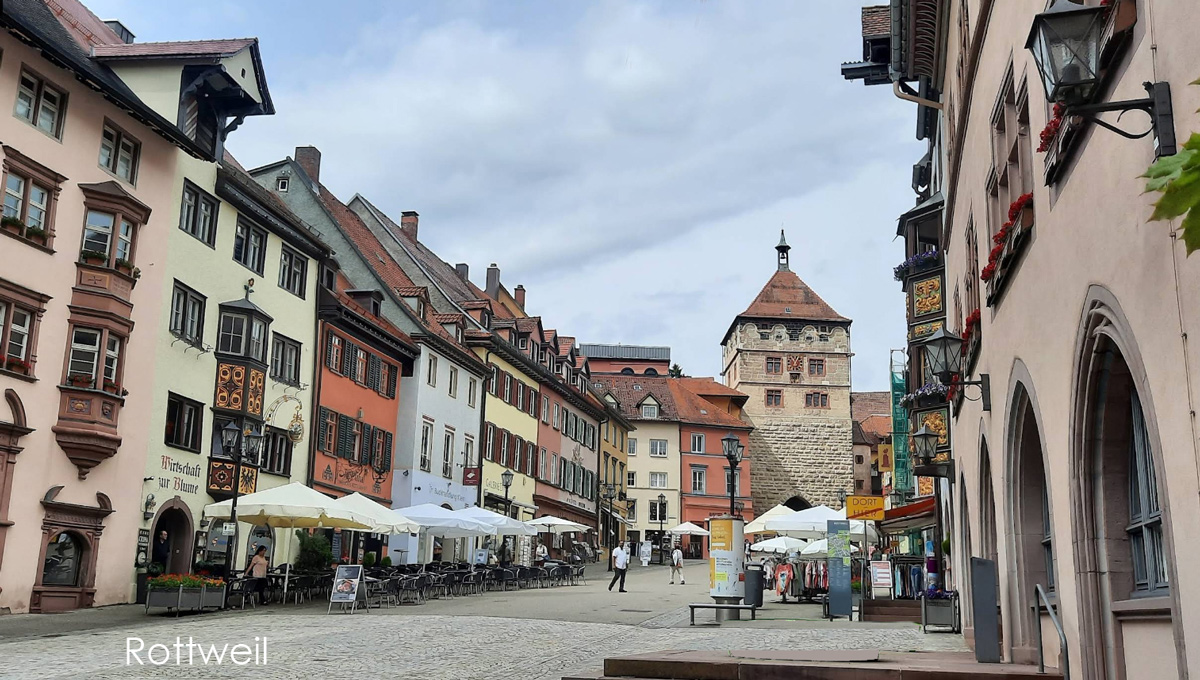
They also used the trip to visit before a few sights. In Rottweil, they stopped for lunch at an Italian (Sardinian) restaurant and in the early afternoon they took a look around Tübingen's city centre.
For their accommodation, they had found a "modern, luxury" apartment in Mössingen.
So they arrived in good spirits for the first lesson on Friday evening in the sports hall of the Schlossberg School in Hechingen.
Friday evening

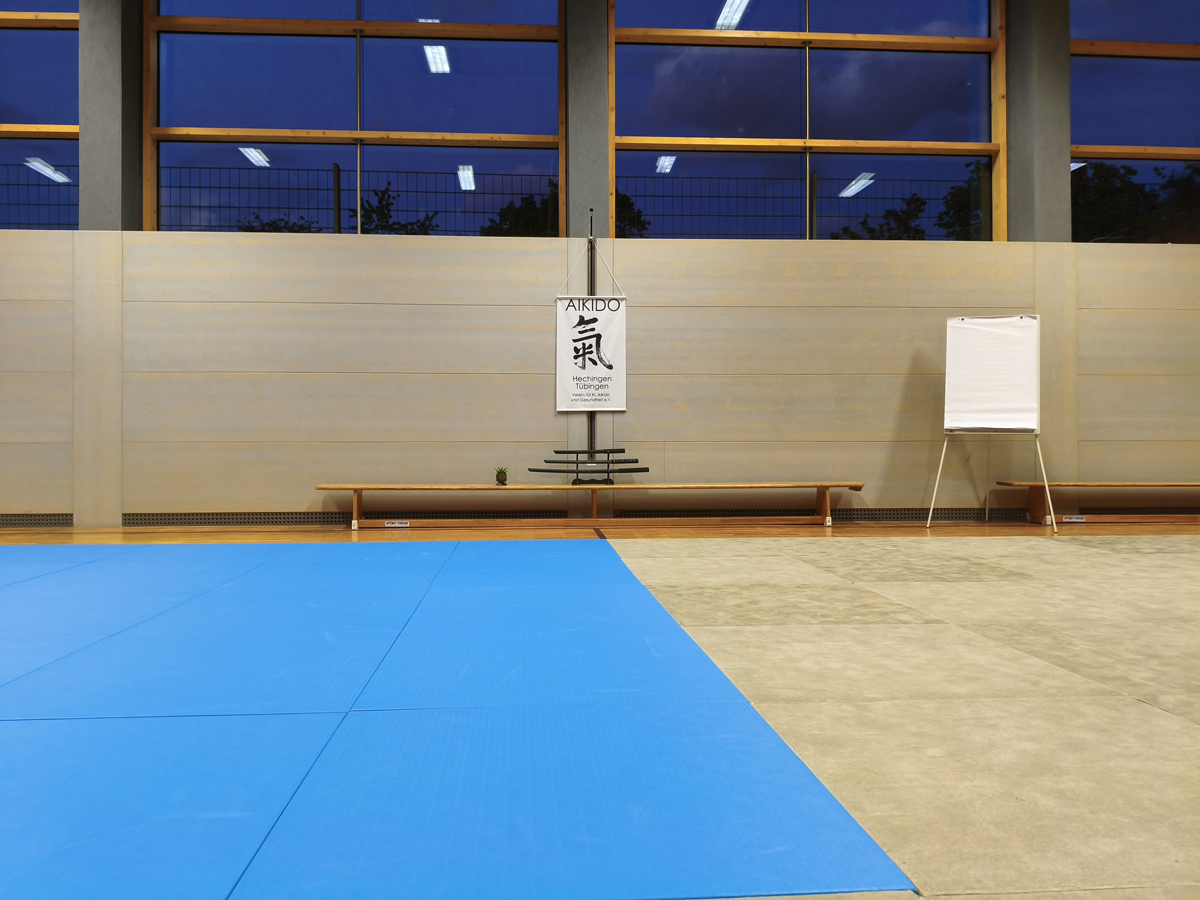
By the time the guests from the south arrived at the sports hall, the Hechingen Aikido club members had already laid out the mats. The lesson started on time.
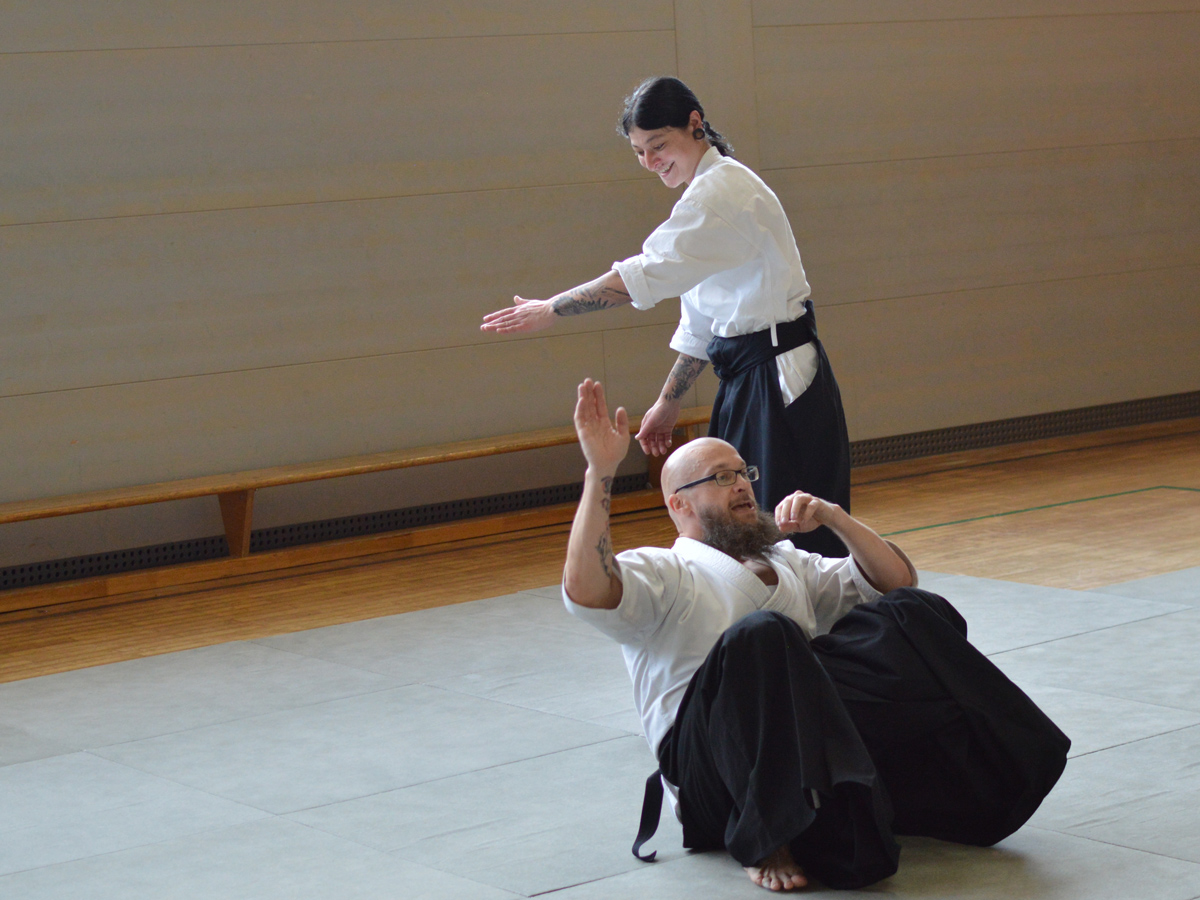
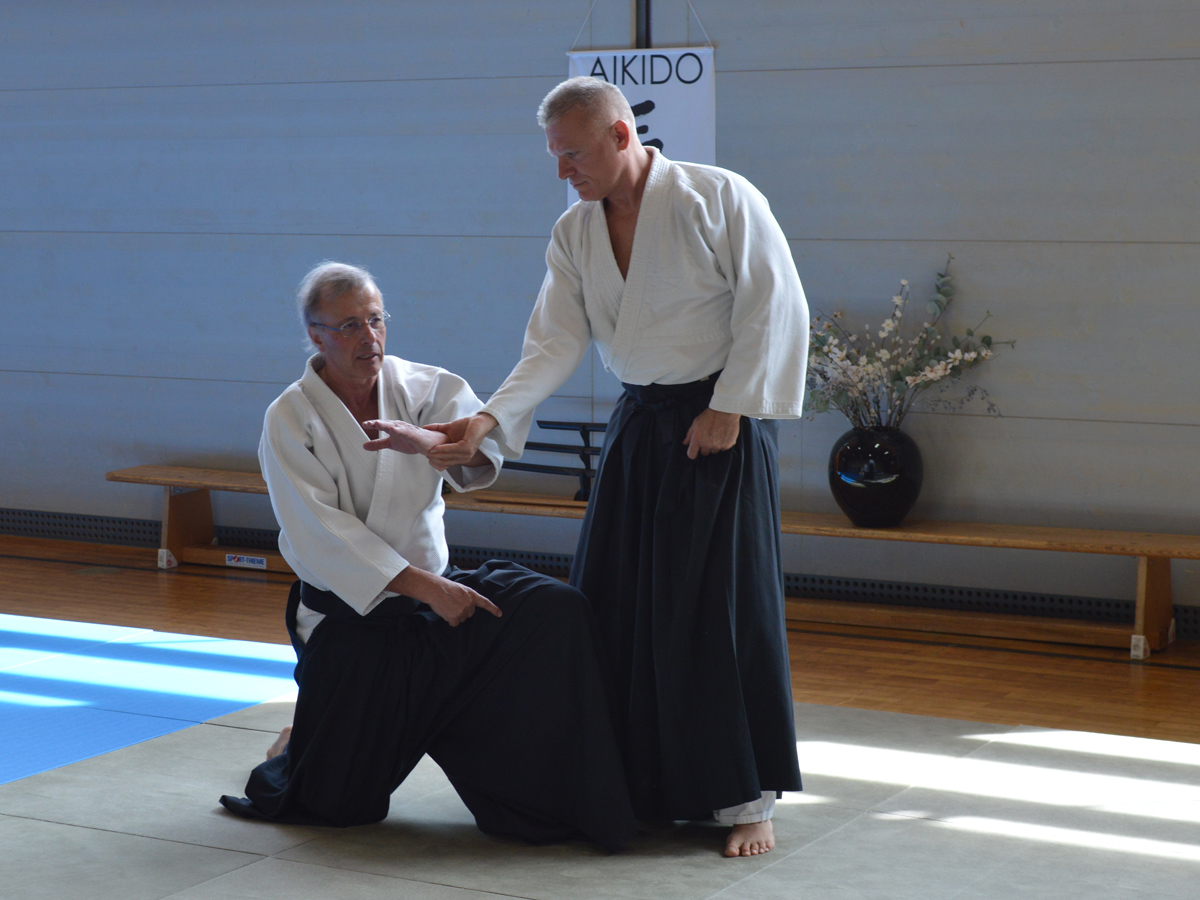
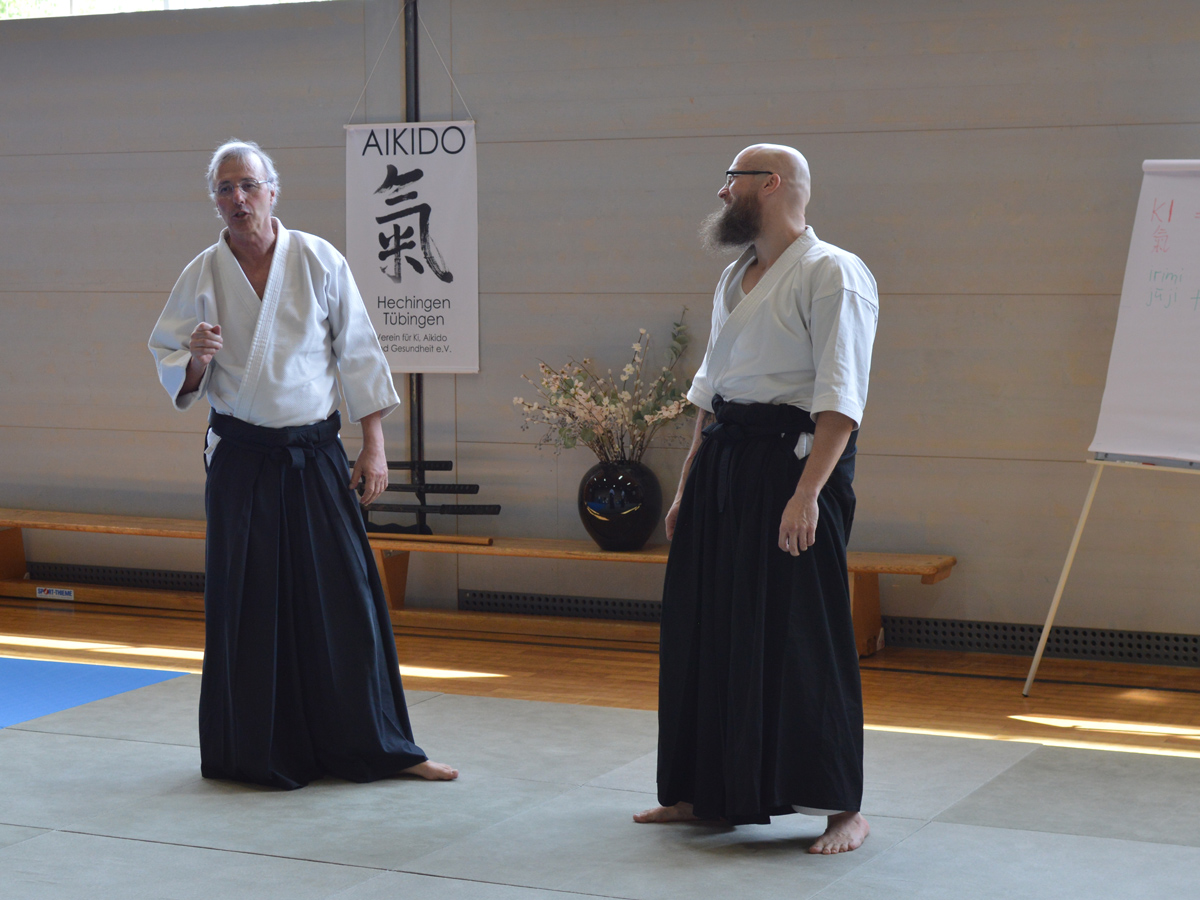
To begin with, Stefan gave a brief overview of the club’s history. He then led the group through a sequence of yoga exercises. Those who were unaccustomed to such exercises had to work quite hard.
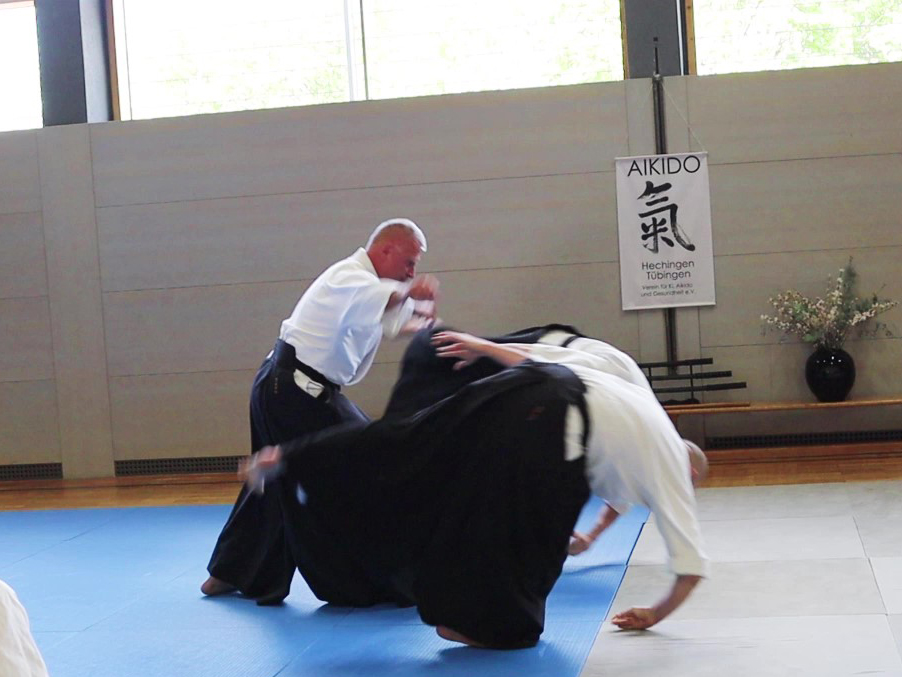
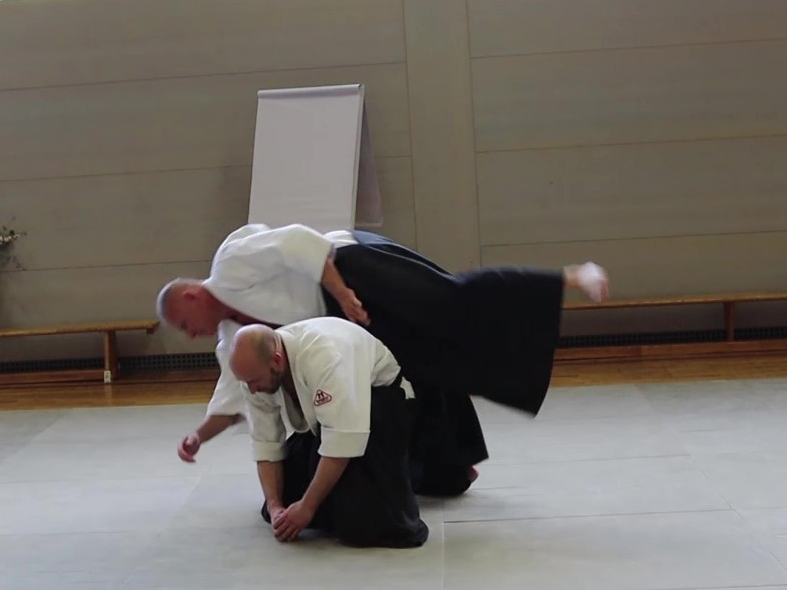
For the aikido session, he had chosen an overview of falling techniques and forms, as well as the appropriate preparations for them, and had the participants practise these accordingly.
Hamza concluded the training with a breathing exercise in seiza.

Saturday morning

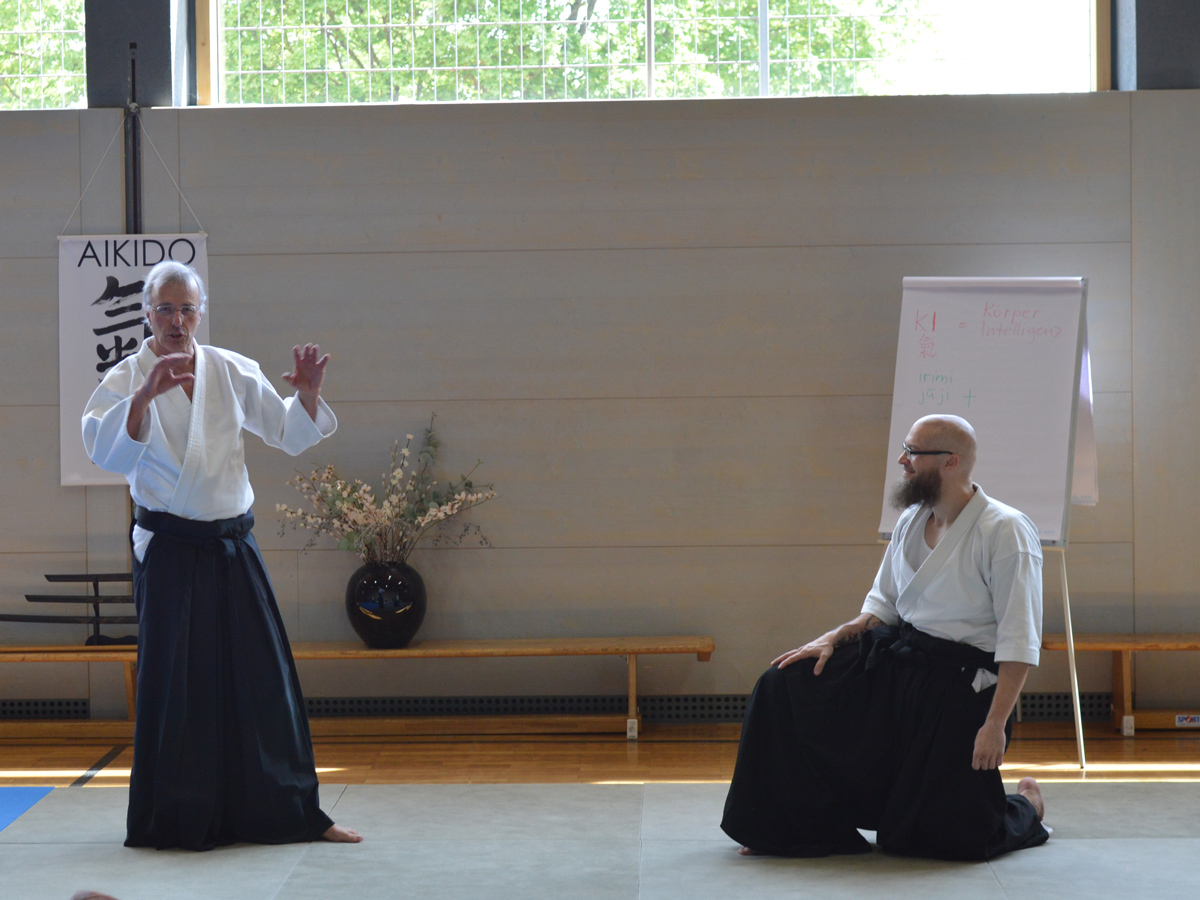
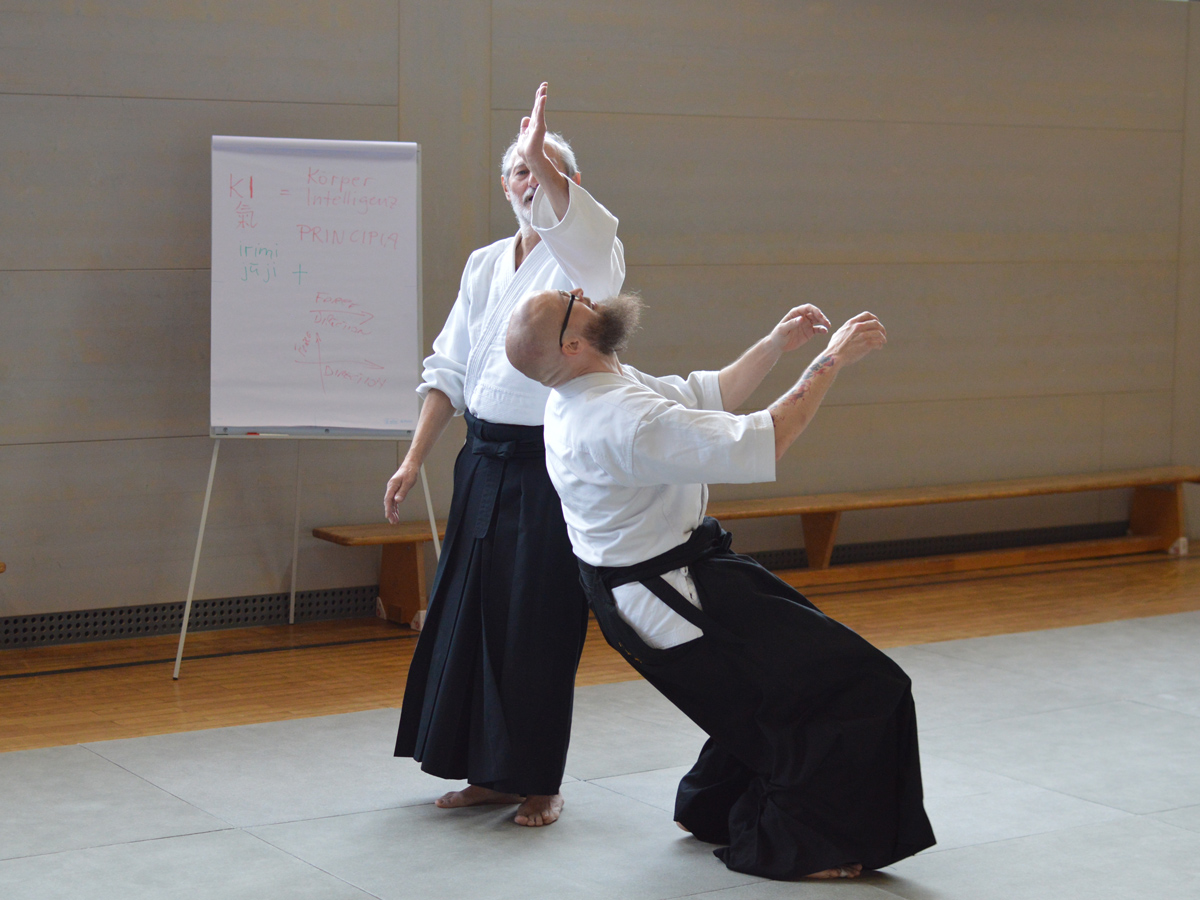
On Saturday morning, Bernhard began by giving a brief overview of the development of Aikido from Daito Ryu Aikijujutsu with Takeda Sokaku, through Ueshiba Morihei and Deguchi Onisaburo, to the systematisation of the techniques by Ueshiba Kisshomaru and Tohei Koichi. He also mentioned the development of Tohei’s Taigi into Yoshigasaki Sensei’s Tsuzukiwaza.
Typical forms of practice in traditional Kobudo and modern Budo are Renzokuwaza and Kaeshiwaza. He had the group practise a few examples of these.
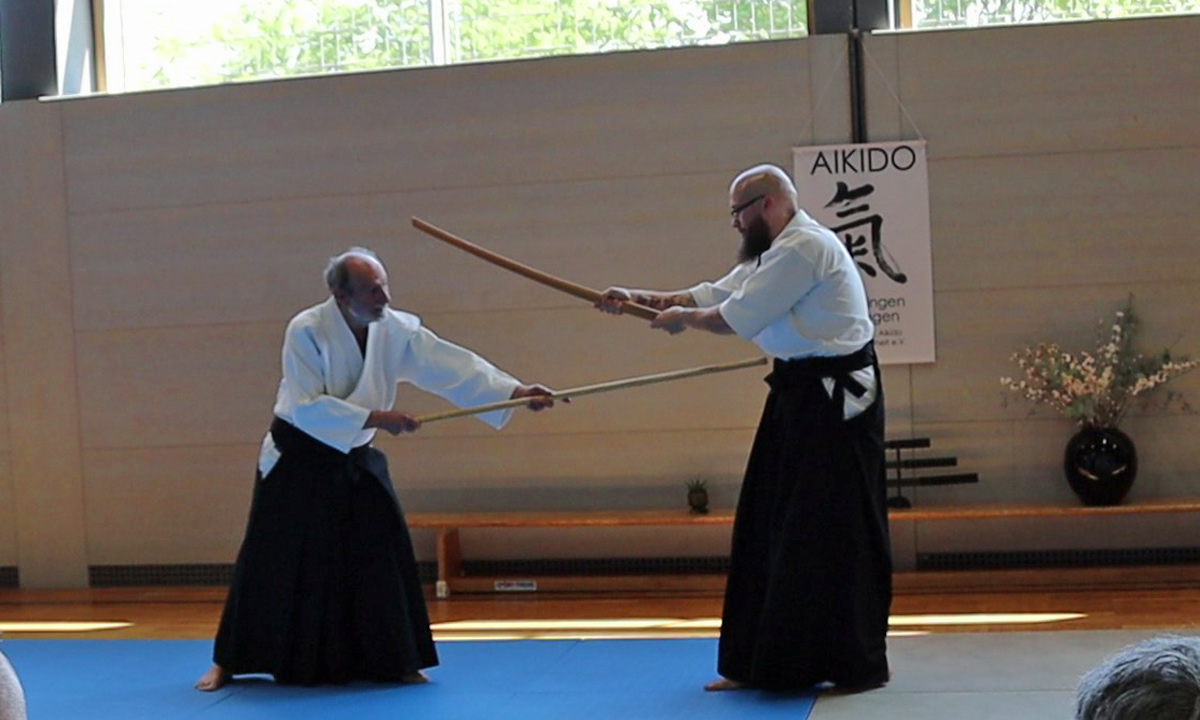
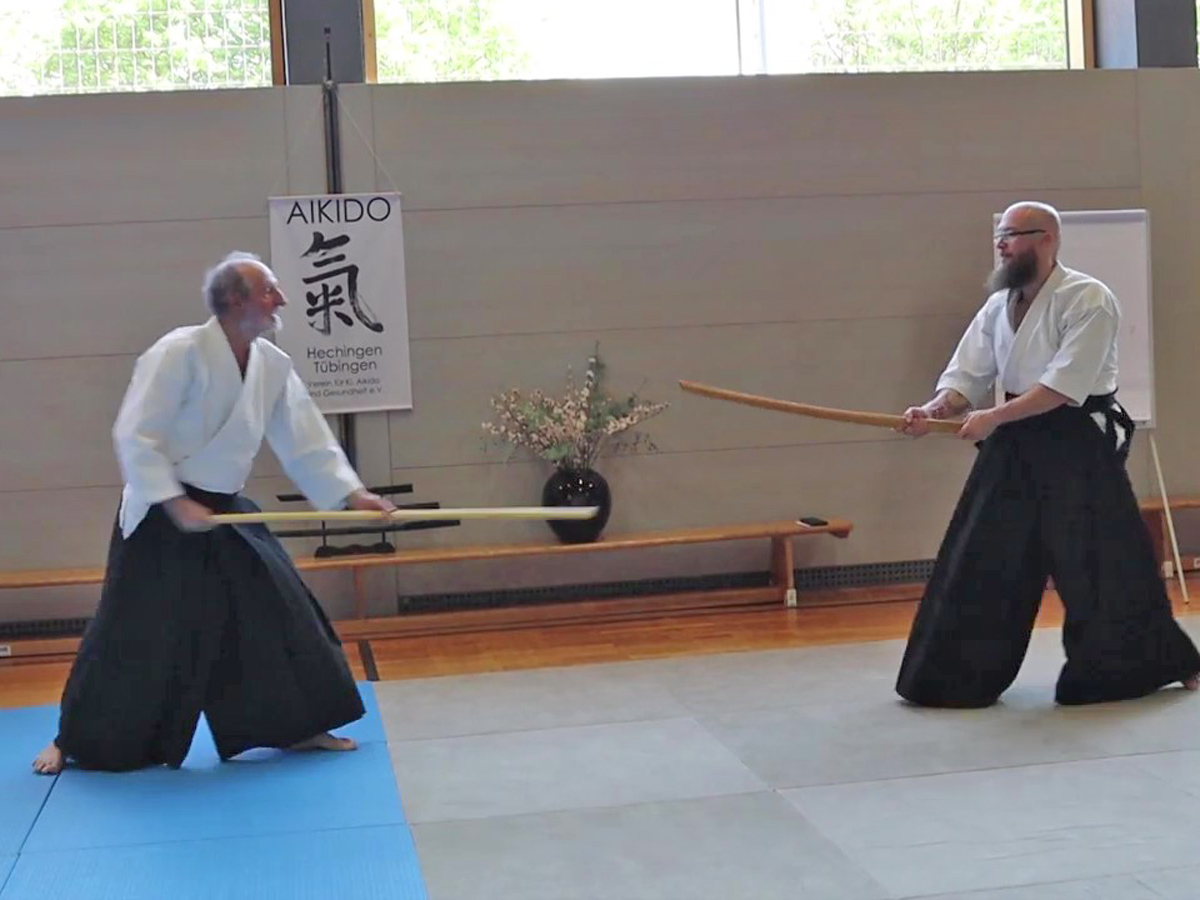
After a short break, Maurizio took over, explaining Jo 1 with bokken in detail. He paid particular attention to the form in the 3rd dan examination, where Nage should control the situation with the bokken.
At the end of the training session, Hamza successfully passed the Ki examination for Joden.

Seminar in Hechingen 05/2026

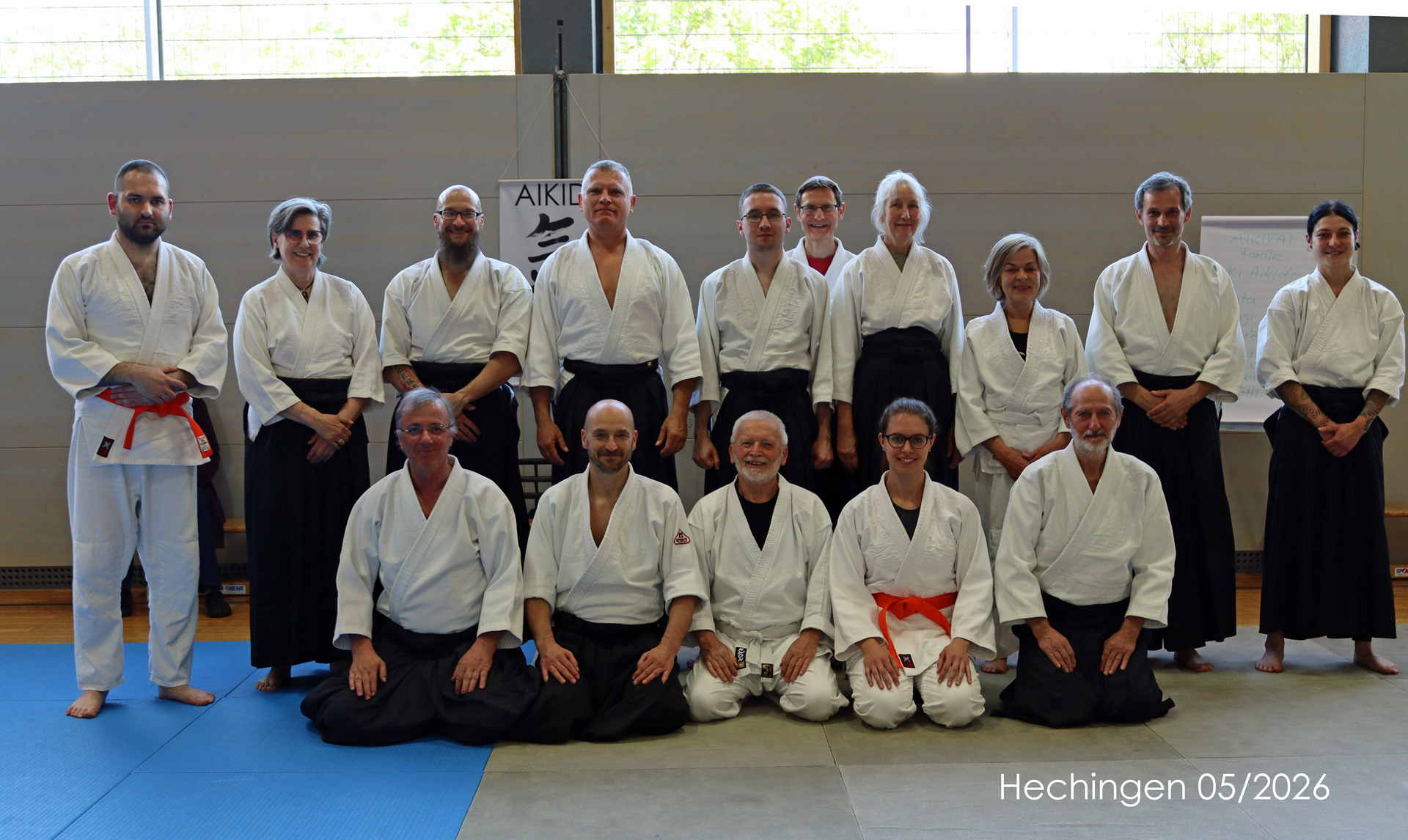
Group photo taken on Saturday morning


Lunch break

The Hechingen aikidoka had ordered pizza for the lunch break, which the participants enjoyed on the sunny forecourt in front of the sports hall.

Saturday afternoon

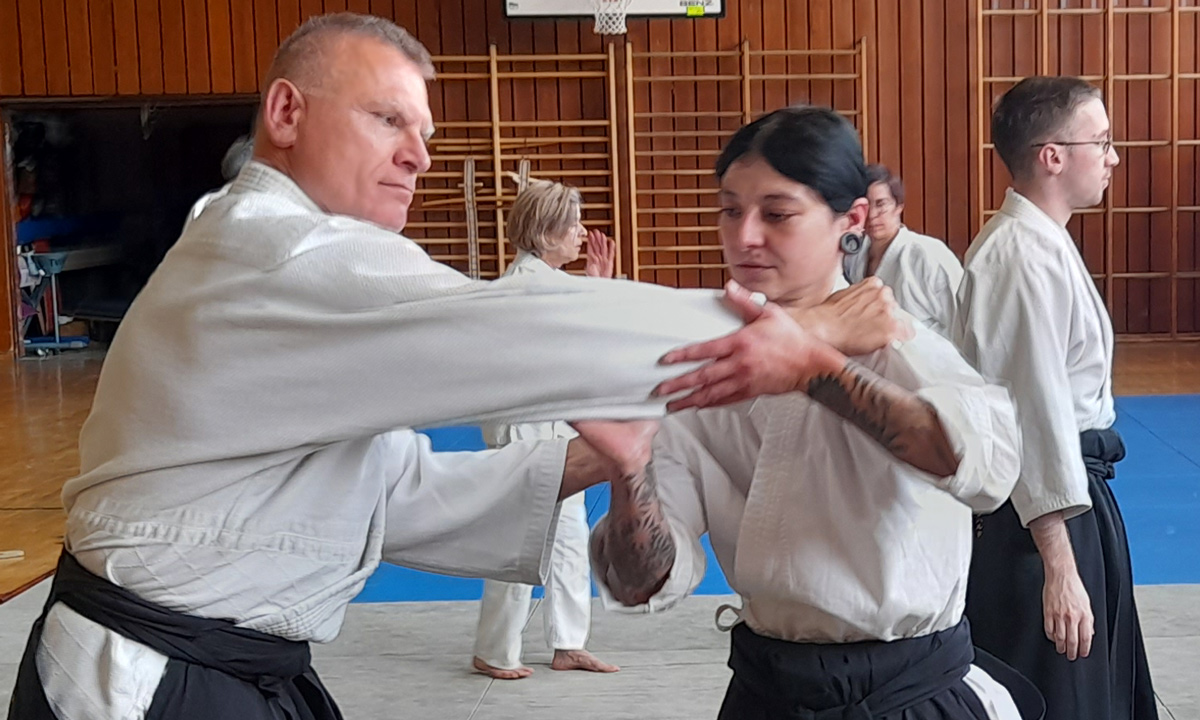
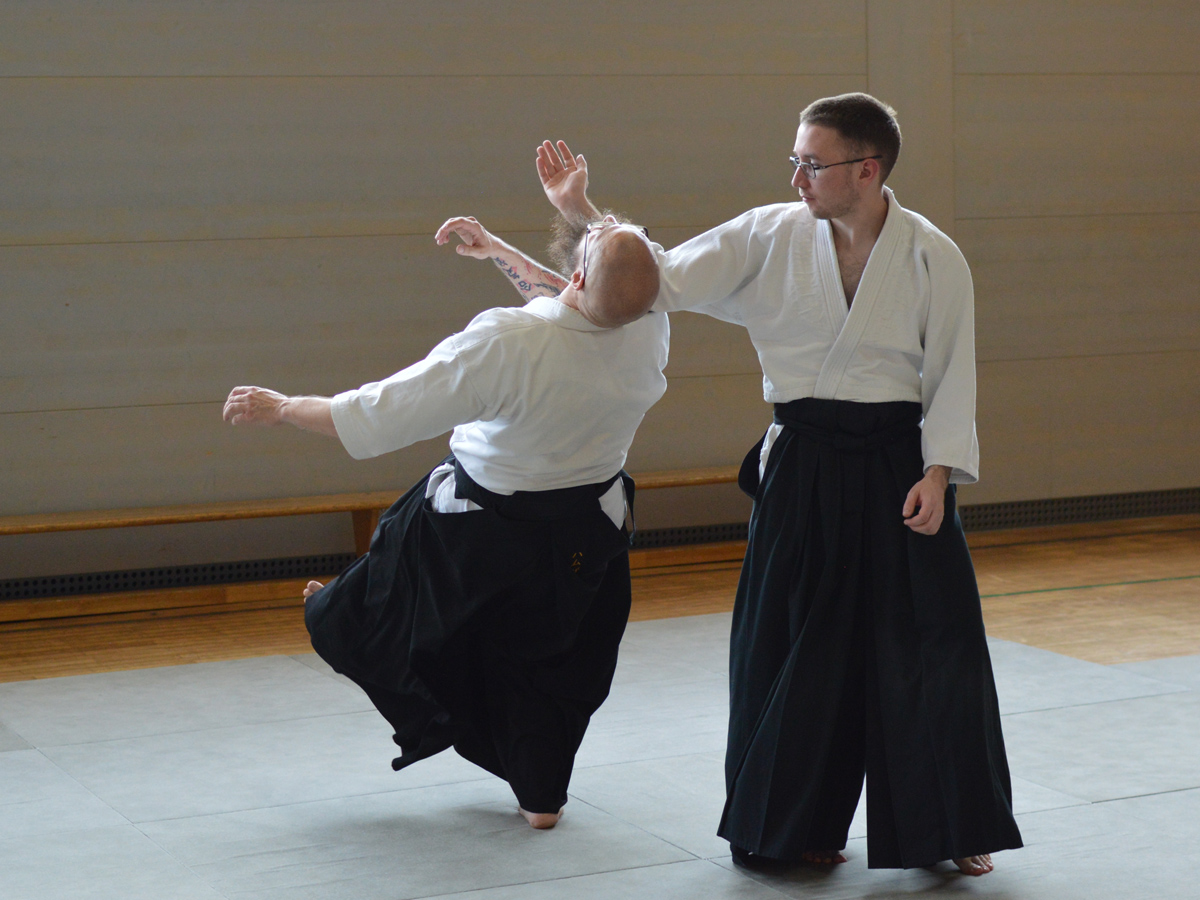
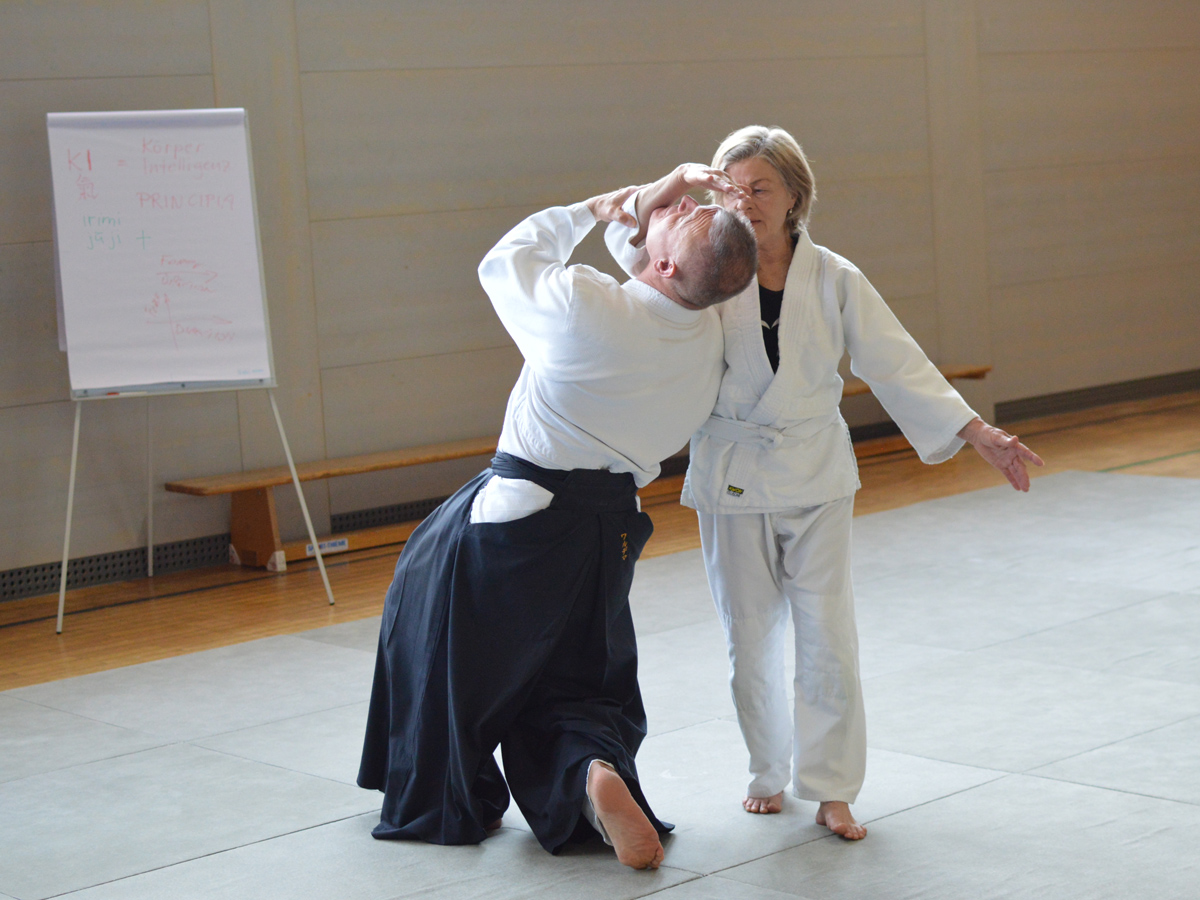
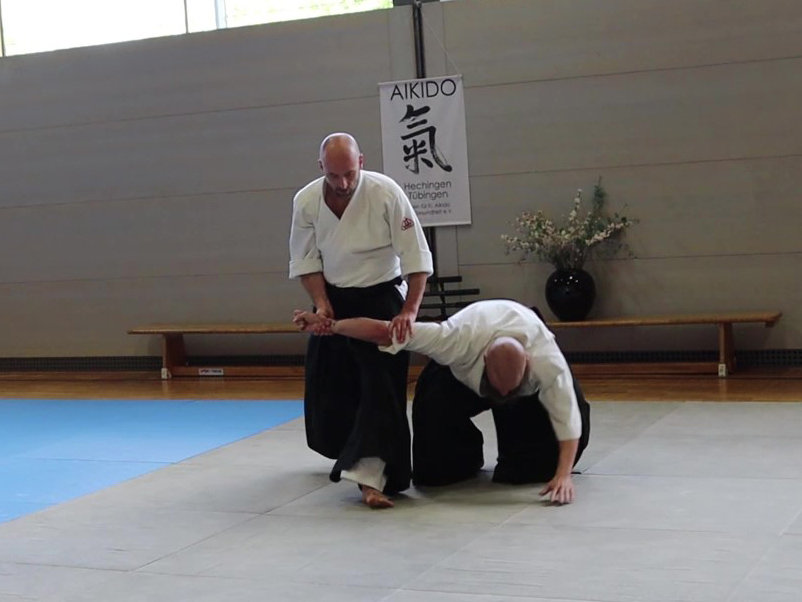
On Saturday afternoon, Bernhard continued the training with basic techniques. In doing so, he placed particular emphasis on the concept of “changing form” and “changing position” as formulated by Yoshigasaki Sensei. Among other things, this concept enables one to break free from a fixation on the outcome of techniques.
In the second part, Maurizio then had the group study the details of Jo 2 with bokken. The lessons ended at 5 pm.

Dan examinations

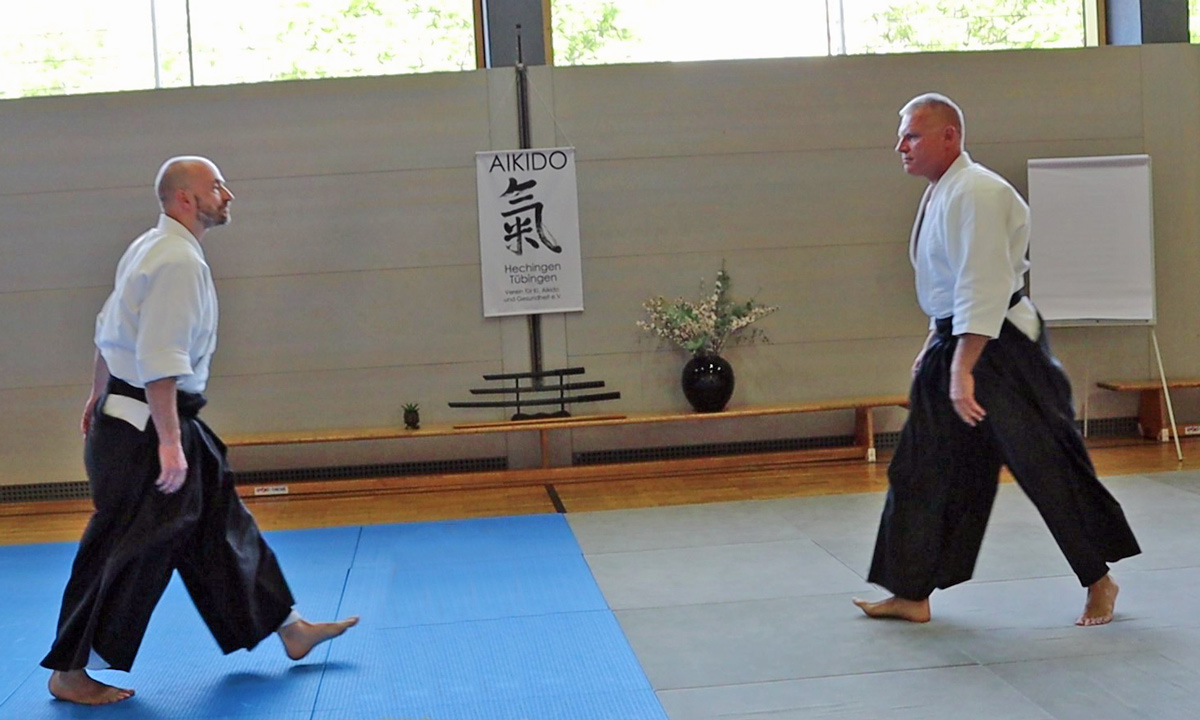
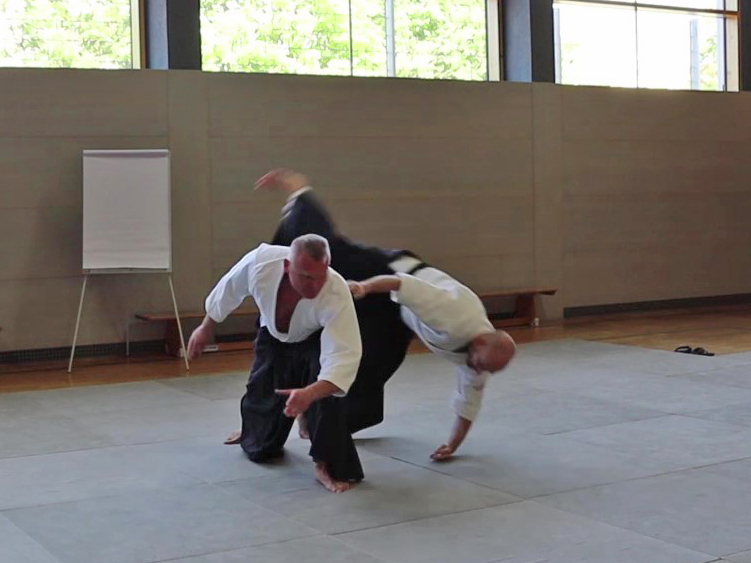
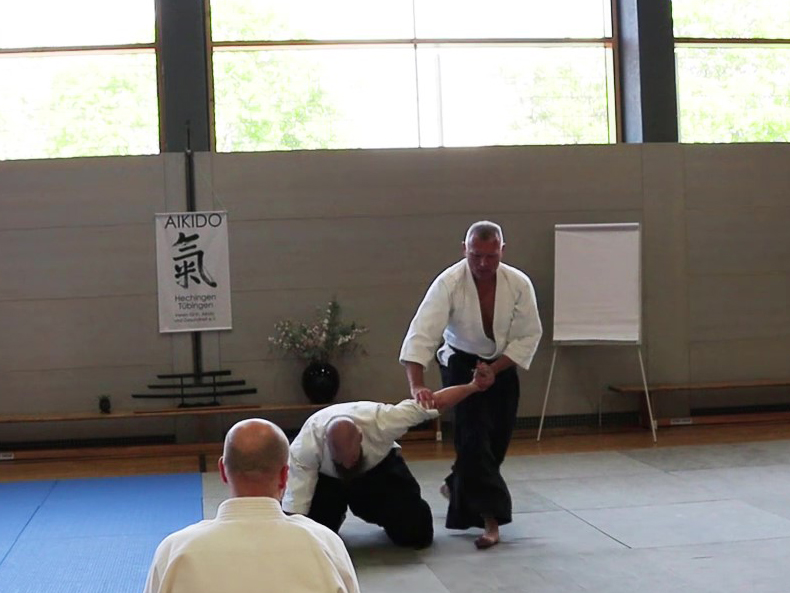
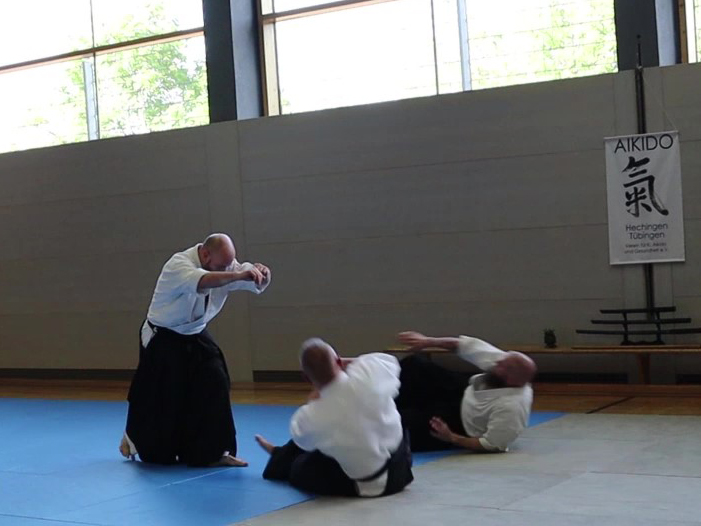
To round off Saturday, Waldemar and Stefan sat their 3rd dan examination. They acted not only as Nage but also as Uke for one another. Hamza was also engaged, as he served as Uke for both of them. During the Sanningake in Tsuzukiwaza 10 and the subsequent Taninzugake (Randori), Christian and Ludwig were the third and the fourth Uke.
Waldemar and Stefan demonstrated the techniques effectively, sparing neither themselves nor their Uke. At the end, they were rewarded with well-deserved applause from the spectators.

Dinner

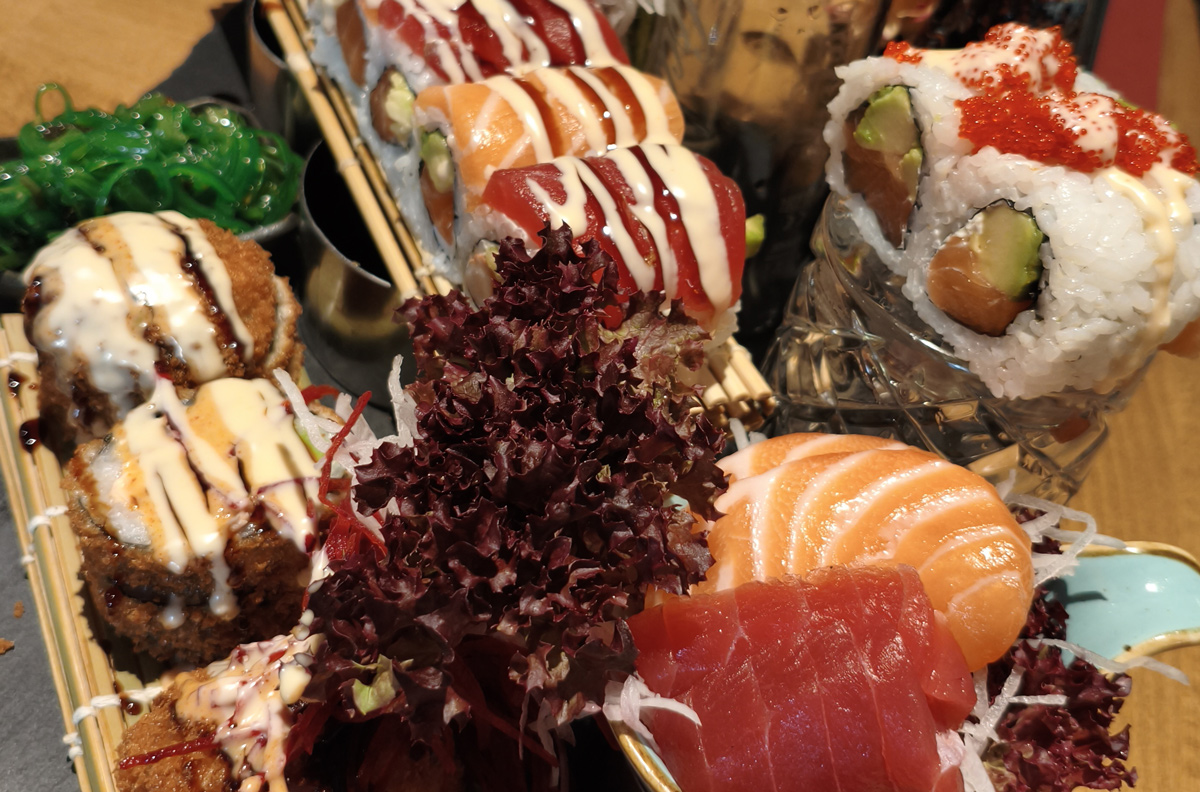
The Association for Ki, Aikido and Health sponsored not only lunch for the participants but also dinner at KAISEKI, a new pan-Asian restaurant in the centre of Hechingen on Obertorplatz. Almost all participants ordered Japanese dishes. These were very tasty and the platters for two were spectacular.
Waldemar, Stefan, Hamza and Bruna were accompanied by their respective partners. The atmosphere was very relaxed and exceptionally fun. Many thanks to the association for organising this dinner.

Sunday morning

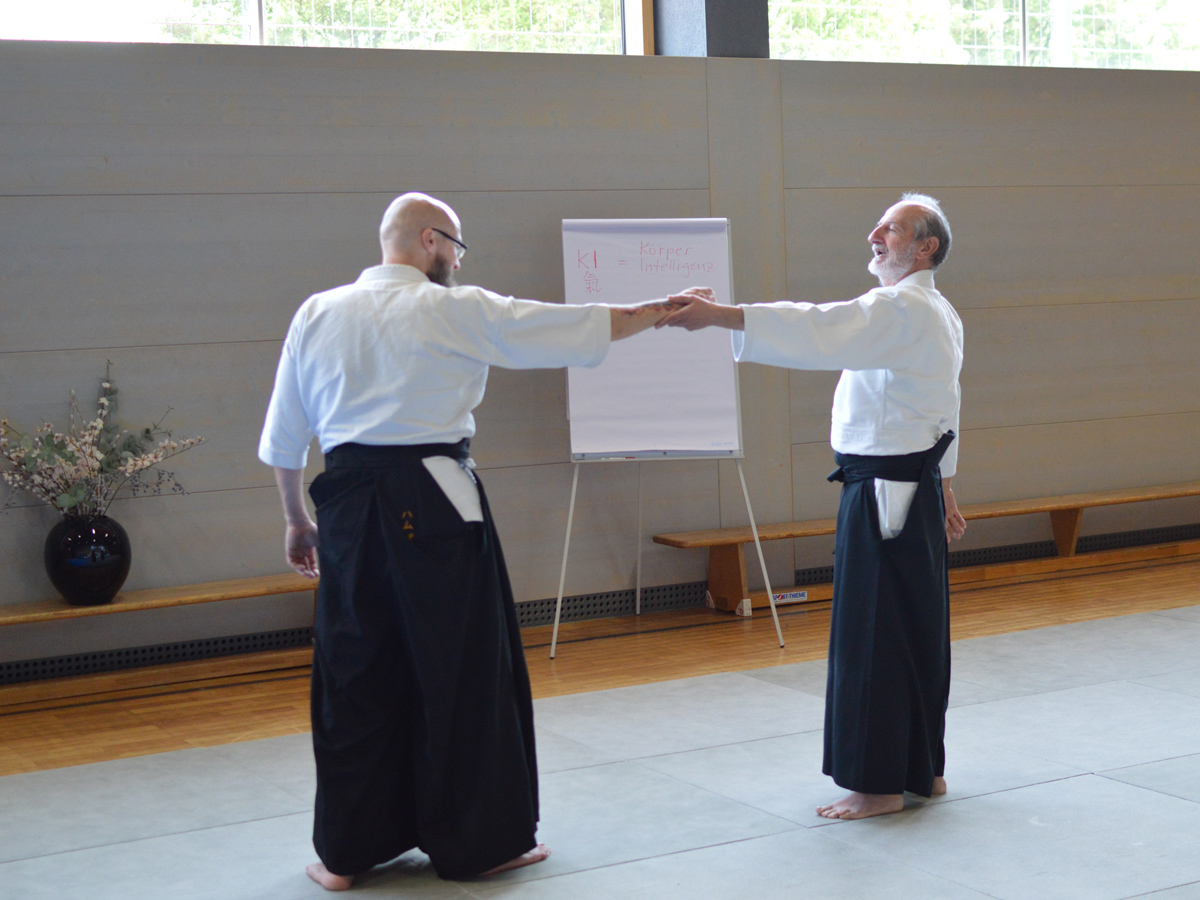
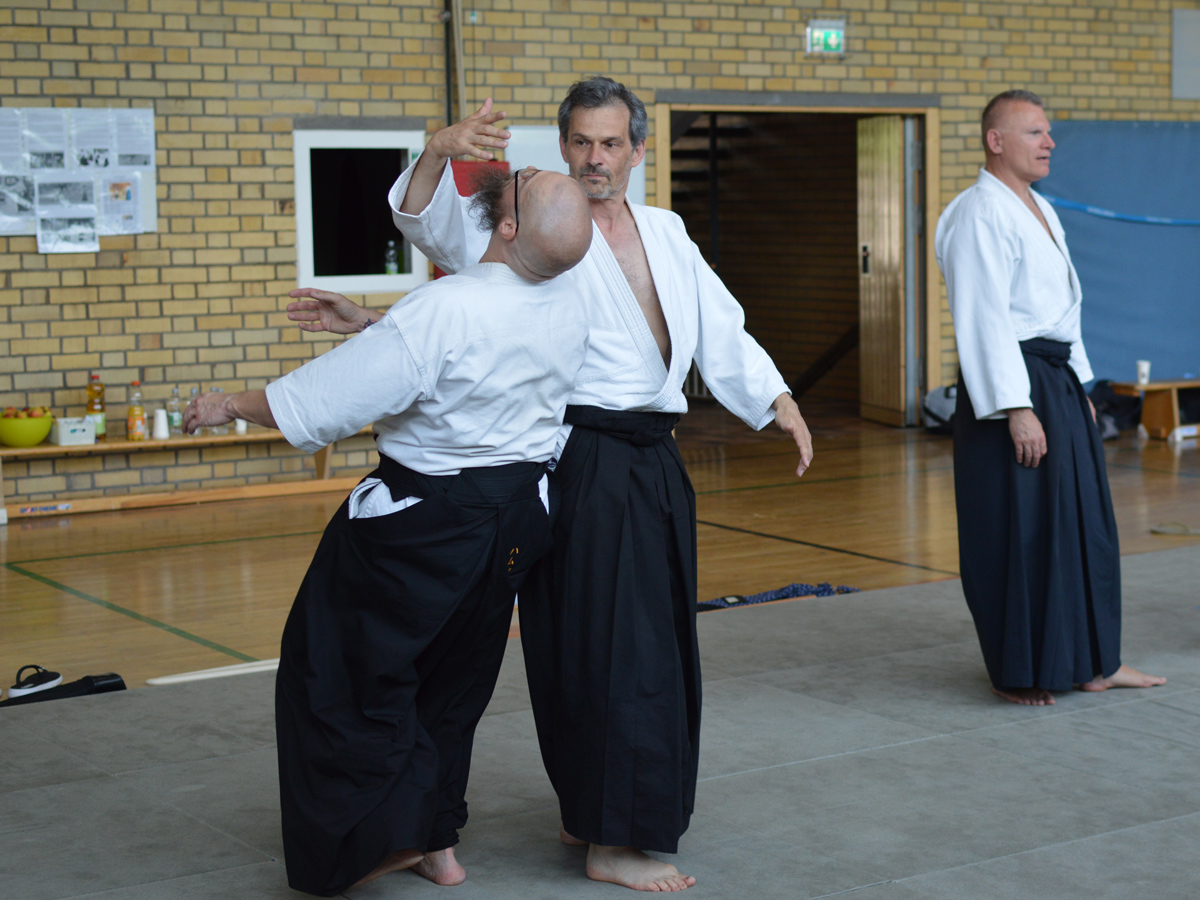
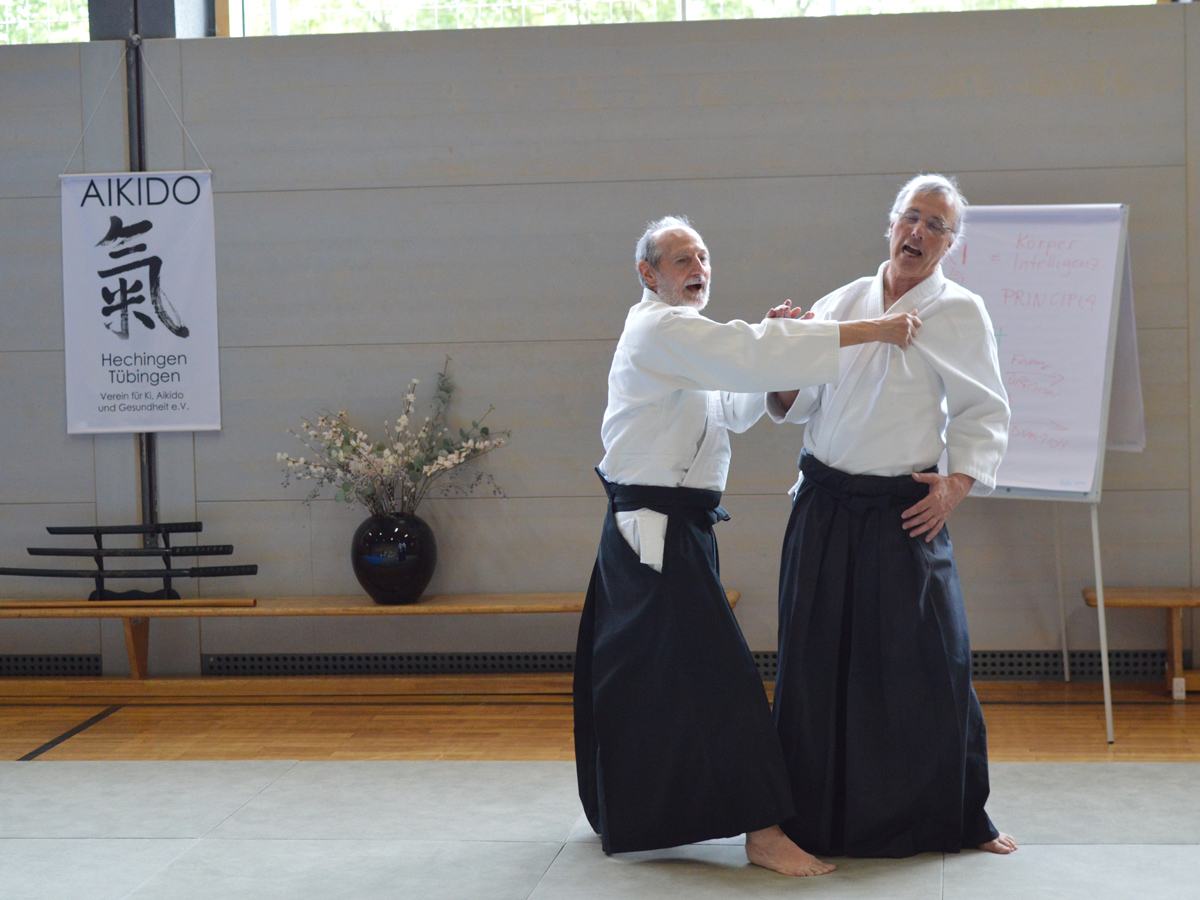
On Sunday morning, Bernhard covered the first part and Maurizio the second part, going into greater depth on some techniques from the 3rd Dan syllabus.
Maurizio repeatedly emphasised that the mind does not move, that the movement should be perpendicular to the direction of the force, that Tohei’s four basic principles are not laws of nature, and that precise rules apply to aikido techniques on the mat.

Return journey

The seminar ended at 1 pm on Sunday. We cleared away the mats together and said our goodbyes, hoping to see each other again soon.
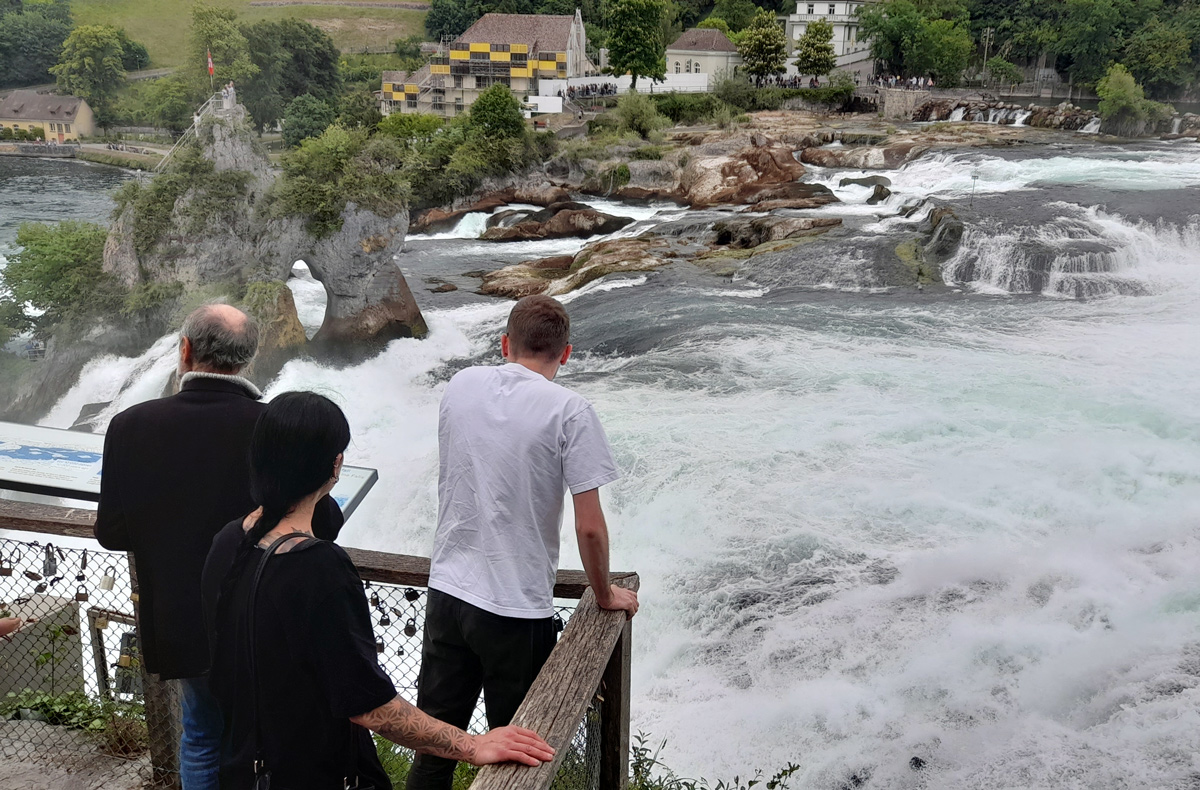
Bernhard surprised the other three from the south with a stop-off at the Rhine Falls near Schaffhausen. Although there were a great many visitors that Sunday, we were able to experience the rushing waters up close at several points on the side of Laufen Castle. For the two Swiss participants and also for the Italian, it was the first time they had been able to witness this iconic Swiss natural spectacle.
Due to heavy traffic, the return journey took a little longer. But everyone could look back with satisfaction on a lovely weekend of aikido and sightseeing.


Hohenzollern Castle

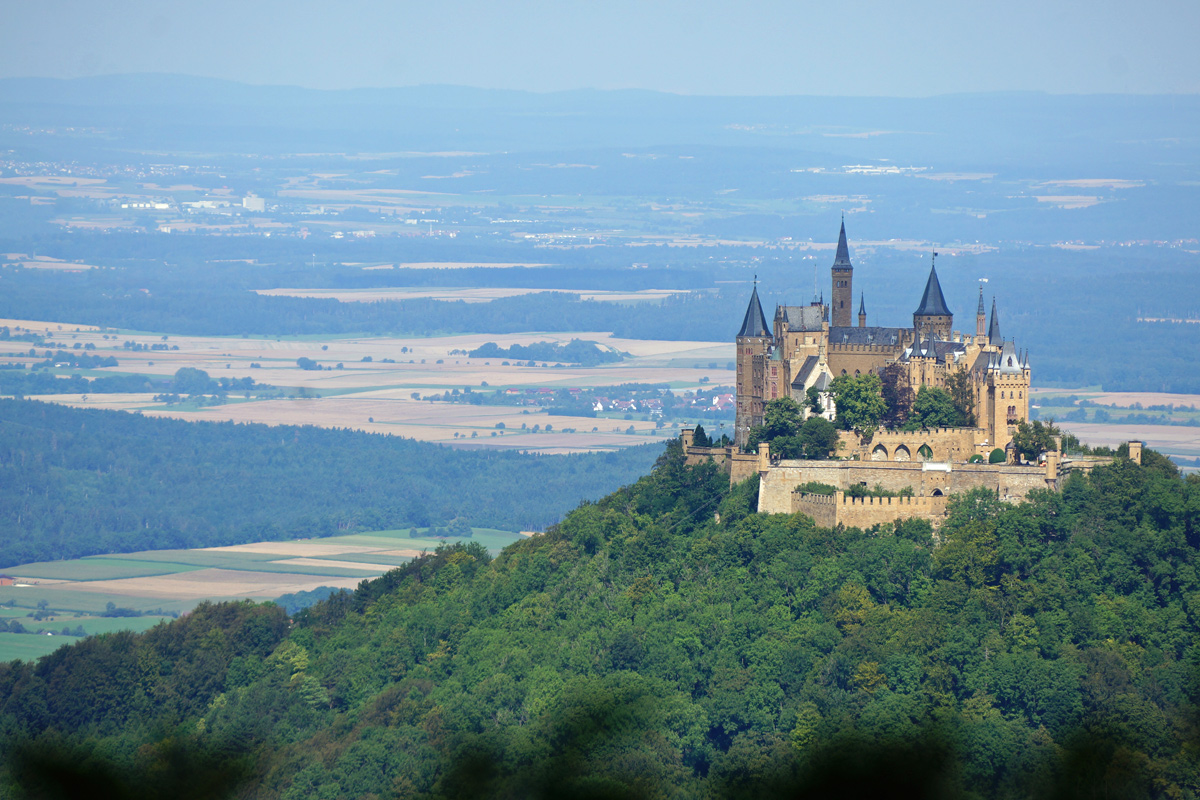
Hohenzollern Castle near Hechingen is the ancestral seat of the House of Hohenzollern. However, the part of the hill on which the castle stands lies within the administrative boundaries of the village of Bisingen, a fact whose residents are always keen to point out.

The Hohenzollern family, originally a Swabian noble house (with estates in Hechingen, Sigmaringen and Haigerloch), provided the Burgraves of Nuremberg in the 13th and 14th centuries. Their rise continued when they became Electors of Brandenburg (Berlin) from 1415. From 1525 onwards, they became Dukes and, from 1701, Kings of Prussia (north of Poland and west of Lithuania).

Prussia is regarded as the cradle of German militarism. Following Prussia’s victory in the war against France in 1871, the numerous German principalities – with the exception of Austria – were united to form the German Empire, although Bavaria never fully agreed to this. From 1871 to 1918, the House of Hohenzollern provided the German emperors. The last German Emperor, Wilhelm II, who reigned from 1888 to 1918, would fit right in with today’s era of potentates and warmongers. After the Second World War, Prussia became part of Poland and Russia.

The predecessor buildings of Hohenzollern Castle were constructed from 1267 onwards and were owned by the older, Swabian branch of the House of Hohenzollern. The present-day neo-Gothic three-winged complex was built from 1850 onwards on the orders of King Frederick William IV of Prussia, based on plans by the architect Friedrich August Stüler, and was completed in 1867. Among the special attractions are the Treasury, the Counts’ Hall and the Chapel of Christ.

With around 350,000 visitors a year, the castle is one of Germany’s most famous attractions. Until a few years ago, you only had to pay an entrance fee if you wanted to visit the castle’s interior as part of a guided tour. Access to the outdoor areas, such as the restaurant, was free of charge. From the castle, you can enjoy a wonderful view of Hechingen, the Alb and the Swabian countryside stretching as far as the Black Forest. The admission fee for adults is now at least 26 euros. Pensioners from Hechingen and Bisingen pay just 6 euros.

The Rhine Falls near Schaffhausen

With a height of 23 metres and a width of 150 metres, the Rhine Falls near Schaffhausen are one of the most impressive waterfalls in Europe.
For a long time, navigating the Rhine Falls was considered impossible. Nevertheless, the Rhine Falls have been navigated by kayak on several occasions. In 1999, boating between Flurlinger Bridge and the Rhine Falls was officially banned. Paddlers face a fine of up to 5,000 Swiss francs.
The central rock of the Rhine Falls, on which the Swiss flag is hoisted, can be reached by small boats from the lower side.